


What’s it like to have lymphoedema and what treatments can help?
Lizzie Sutton

‘I work hard to manage my lymphoedema symptoms’
Lizzie Sutton, a 45-year-old event planner from south London, who is married with a 12-year-old daughter was diagnosed with de novo metastatic breast cancer (cancer that has already spread to other parts of the body at the time of first diagnosis) in 2014 and underwent chemotherapy, radiotherapy and a mastectomy. She later developed lymphoedema.
‘I’d been diagnosed with breast cancer when my daughter was a year old after my whole breast just went hard – I didn’t have a discernible lump as such. It was a huge shock as I’d felt so well and just gone back to work.
The treatment was pretty gruelling, but I got through it. I’d had a sentinel node biopsy to check for cancerous cells and had a lymph node removed .
Then two years after my treatment finished, I noticed my wrist was getting larger. I’d been doing quite a bit of yoga, so I just assumed I’d been overdoing it, although it didn’t hurt at all. Six months later I mentioned it to my breast care nurse, and she said it was probably lymphoedema.
I was referred to a lymphoedema service, and the initial treatment was bandaging, I had to go every day for three weeks. Each time they would massage my arm and then bandage it up again to shift fluid back into the bloodstream. They also put my arm into an air pump –it was like an arm mattress for my arm.
During this three-week period, it looked like I had a broken arm as they put it in a cast. They would keep checking my wrist measurements to see if the swelling was going down.
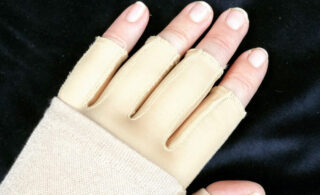
After that they gave me two pressure garment sleeves to wear on my arm, one for daytime and one to wear at night to maintain the effects. They are custom made for the size of your arm. I was self-conscious about it at first but have got used to it over the years. The only time when it gets uncomfortable is in hot weather when my arm tends to swell more. I get a new set sent to me every six months.
My lymphoedema doesn’t cause me any pain, but I have had cellulitis, a bacterial infection of the deep layers of the skin twice (people with lymphoedema are more prone to it. Each time my skin got very hot to touch around the elbow area. The first time I went to A and E and told them I thought it was lymphoedema and at first they were only going to prescribe a week’s worth of antibiotics. My lymphoedema nurse had told me that cellulitis can get serious quite quickly and to go to A and E right away if I had symptoms. She also warned me that I would need a two-week course of antibiotics as seven days wouldn’t be enough, and to remind the doctor I had lymphoedema. When it happened a second time, I knew exactly what to do and told them what was wrong at A and E and what I needed, they didn’t seem to know much about lymphoedema. Both times it cleared up quite quickly.
I look after my skin by moisturising it every day and I’ll use a massage technique the nurse taught me to reduce the swelling. I’ll start by massaging under my collarbone of the affected side three times, then put one hand underneath my armpit using a pumping movement three times, and gradually work my way down the arm, but sweeping upwards as I go. This stimulates the lymph glands to start draining. I’ll also use a soft body brush on my arm too, I think it all helps keep the swelling down.
I also still wear a compression sleeve every day and another one in the evening and overnight.
I do everything I can to stay healthy by exercising. I think if you start low and work up gradually you’ll be fine – I did once overdo it with lifting kettlebells though. I also do yoga and Pilates and shake my hands above my head to stimulate circulation.
I also pay privately for regular full body massages at a lymphatic drainage clinic, which I find helps.
Lymphoedema has affected my whole arm now, not just my wrist, and my affected arm is noticeably bigger than the other. I find writing harder now too and just holding a hairdryer can cause quite an ache. If I am holding my arm up for any period of time, I’ll feel it.
I don’t think lymphoedema is taken seriously enough, it really affects my daily life and isn’t trivial, and I don’t think enough people understand what it is – I certainly found that at A and E. There needs to be more education for health care professionals. The NHS lymphoedema clinic I attend is great, but I know not everyone gets access to place like this, and the clinics that do exist are under a lot of pressure.
My message to others who develop lymphoedema is to seek medical help early on, there’s no cure, but treatments can relieve symptoms and stop them progressing or slow them down.’
Zoe Yessaian

‘I had breast lymphoedema’
Zoe Yessaian, 37, a nurse and psychosexual therapist from London, was diagnosed with ER PR hormonal breast cancer in August 2024 and treated with a lumpectomy, chemotherapy, and radiotherapy. She later developed lymphoedema in her breast.
‘I started noticing I noticed a build-up of weird tissue in the breast in which I had a lumpectomy about a year after my diagnosis. There was an area that felt lumpy under the breast, and I panicked slightly and thought what’s this? It felt lumpy and looked like orange peel skin with indentations.
My first worry was that it was another lump – it clearly wasn’t right. It didn’t hurt, it just looked and felt weird. I also had some aching in my arm, but no swelling there.
I went to my breast care nurse, and they referred me to a lymphoedema clinic where they confirmed it was breast lymphoedema. I had no idea you could even get lymphoedema in the breast. I was so relieved it wasn’t cancer, or lymphoedema in my arm.
The nurse told me to get a well-fitting bra that lifts the breasts so that there is room for the lymph fluid to move and drain away and also gave me some foam to put inside my bra to help lift my breast more, which she customised to fit me.
Both really helped a lot – it took about six months to improve it’s not fully gone, but it’s much better than it was, and I am now on six monthly follow ups.
I also have regular scar tissue massages at Future Dreams House once a month too, which really helps, and I strongly recommend! Future Dreams also have a great bra lounge if you need bra fitting too! ‘
Sophia Sewell

‘It took me years to get a diagnosis for my lymphoedema’
Sophia Sewell, 52, a mother of one, lives in east London and works as a family assessment worker in health and social care. She was diagnosed with primary breast cancer in November 2013 and had lymph nodes removed as part of her treatment, which included chemotherapy, radiotherapy, and tamoxifen tablets for 10 years. In 2024 she was diagnosed with metastatic breast cancer which had travelled to the lungs.
‘My lymphoedema started in 2020 during the lockdown – I noticed my arm was slightly swollen and also my legs had become heavy and painful.
I had no idea what was causing it, and neither did my primary care doctors – they didn’t connect my symptoms with my breast cancer treatment even though they knew my medical history.
At first, I was prescribed water tablets as they thought the swelling in my legs was water retention. I took the tablets, but they didn’t help at all.
At one point I had an ultrasound as they suspected a circulation problem, or a deep vein thrombosis clot, but they couldn’t find anything wrong.

It was very frustrating as I was in a lot of pain in my legs – I’d get electric shock and burning type pains in my legs when I walked anywhere. I also had pain in my bum and thighs too – everything felt so heavy. I really worried about what was wrong with me.
It took two years for them to work out what was the issue; I had lymphoedema, which my mother who’d also had breast cancer, had too. The doctors said they couldn’t say for sure whether my breast cancer treatment had caused it or not, but said it was possible, or that it could be related to taking tamoxifen. They weren’t 100 per cent sure.
I just felt relieved to know what was causing the problem. I was referred to the lymphoedema clinic, and they told me to stop the water tablets straight away as they weren’t doing anything at all. They measured my legs and I had compression sleeves for my legs made which I wear every day and sometimes at night. They really help – without them I can’t walk without pain and discomfort.
I’ve reached that point now that I’ve learnt to live with and manage my lymphoedema symptoms, as I’m aware it’s irreversible, it’s just frustrating that I couldn’t get a diagnosis sooner. I don’t think doctors and nurses in primary care know enough about lymphoedema and the different symptoms it can cause and know fully how to diagnose.’
Further information
Future Dreams hold a range of support groups, classes, workshops and events to help you and your carers during your breast cancer diagnosis. These are held both online and in person at the London-based Future Dreams House. To see what’s on offer and to book your place, see here.
To return to the homepage of our Information Hub, click here where you can access more helpful information, practical advice, personal stories and more.
The information and content provided in all guest articles is intended for information and educational purposes only and is not intended to substitute for professional medical advice. It is important that all personalised care decisions should be made by your medical team. Please contact your medical team for advice on anything covered in this article and/or in relation to your personal situation. Please note that unless otherwise stated, Future Dreams has no affiliation to the guest author of this article and he/she/they have not been paid to write this article. There may be alternative options/products/information available which we encourage you to research when making decisions about treatment and support. The content of this article was created by Dr Tasha Gandamihardja, an oncoplastic breast surgeon and podcaster and we accept no responsibility for the accuracy or otherwise of the contents of this article.
Share


SUPPORT RESEARCH EDUCATION
Donate to those touched by breast cancer
Sylvie and Danielle began Future Dreams with just £100 in 2008. They believed nobody should face breast cancer alone. Their legacy lives on in Future Dreams. We couldn’t continue to fund support services for those touched by breast cancer, raise awareness of breast cancer and promote early diagnosis and advance research into secondary breast cancer without your help. Please consider partnering with us or making a donation.