


Get some straight science-backed answers to commonly asked questions about lymphoedema from former breast cancer surgeon Dr Liz O’Riordan, who has had breast cancer three times, author of The Cancer Road Map and Dr Kelvin Ramsey a consultant lymphoedema surgeon at the Royal Marsden NHS Foundation Trust
Lymphoedema, swelling of the arms and less commonly the breast, after lymph node surgery or radiotherapy for breast cancer can be painful, unsightly and cause a heavy dragging sensation.
It sucks and frankly it’s just one more thing you could do without after dealing with breast cancer treatment.
And whilst it’s true that most people that have breast cancer don’t get lymphoedema. if you are affected, the symptoms can be debilitating, progressive and hard to control, as well as being a constant reminder that you’ve had breast cancer.
But although there’s currently no cure, there are treatments that can help, and these generally work better the sooner you start them after you notice symptoms.
What is lymphoedema?
Dr Liz O’Riordan explains that lymphoedema can happen after lymph node surgery to remove lymph nodes and radiotherapy.
‘Lymph vessels collect fluid from your tissues. This gets filtered in your lymph nodes and returned to your bloodstream,’ says Dr O’Riordan.
‘If your armpit nodes have been removed or treated with radiotherapy, it can slow down the filtering. This means fluid builds up in your hand and arm.’
Less commonly fluid can build up in breast tissue and the chest area too, causing swelling, skin changes, aching, tenderness and tightness. Chronic breast lymphoedema persists after 6 to 8 weeks post-surgery. i
How common is lymphoedema
‘This depends on what type of lymph node surgery you’ve had, explains Mr Kelvin Ramsey, Consultant Plastic and Reconstructive surgeon at the Royal Marsden NHS Foundation Trust.
If you have a sentinel node biopsy (this is where one to three lymph nodes are removed) then the rates of lymphoedema are very low, five per cent or less. But if you have an axillary clearance, where all or most of the lymph nodes are removed from the armpit (the axilla) the rate of lymphoedema goes up to around 30 per cent.’
‘A targeted auxiliary dissection is another type of lymph node surgery where breast cancer surgeons remove the most important lymph nodes that are draining the breast, but not those that affect the arm as much, so the rate of lymphoedema is around 10 to 15 per cent,’ says Mr Ramsey.
When do the symptoms start?
It’s normal to have some swelling in the weeks following lymph node surgery and in most cases, this will settle within a few weeks.
Chronic (long term) lymphoedema that persists can start any time after lymph node surgery, usually months or sometimes years later. ii
‘If lymphoedema does develop, catching it early makes a huge difference,’ says Dr O’ Riordan. ‘Treatments seem to be more effective the earlier they are done.’
What are the early symptoms of lymphoedema in your arm?
‘You’ll usually feel it before you see it’, says Dr O’Riordan, ‘You may feel a heaviness in your arm, a dull ache, tingling and a sense that something isn’t quite right.
‘After that you may notice your rings are tighter, watches feel snug and your sleeves are leaving marks.’
Your symptoms may get better overnight and be worse during the day, but without treatment they will usually progress to being more severe and persistent. iii
‘A useful test to do if you suspect you have lymphoedema is to press your thumb into the skin on the back of your hand. If it springs back — that’s reassuring. If it stays indented briefly — get checked,’ says Dr O’Riordan.
What about later lymphoedema symptoms?
The most obvious one is more swelling of your arm – one arm may look or measure a noticeably bigger circumference than the other. This can happen in part of your arm or the whole arm.
Other symptoms include developing hard, tight, or thickened areas of skin or lymph fluid leaking through the skin, folds developing in the skin and wart–like growths. iv
What are the symptoms of breast lymphoedema?
‘Breast lymphoedema affects around one in 10 women v who have had a lumpectomy and radiotherapy to treat their breast cancer,’ says Dr O’ Riordan.
‘This happens after radiotherapy. The radiation disrupts lymphatic drainage in the breast tissue itself,’ says Dr O’ Riordan,
‘You might notice heaviness in your breast, aching at the end of the day, swelling, thickened or pitting (orange peel) skin.’
Other symptoms can include darker skin developing and marks from bra straps and seams appearing on your skin. vi
How ‘bad’ are lymphoedema symptoms?
‘Lymphoedema symptoms are on a spectrum – they can range from mild to very debilitating and symptoms may get progressively worse even if they start off as just a minor inconvenience,’ says Mr Ramsey.
‘They are by no means trivial though and can have the potential to affect quality of life and even the job you do without treatments, but they can be managed with lymphatic massage, compression garments and even surgery (see below) in some cases and you shouldn’t have to just put up with them.’
Can you prevent lymphoedema?
‘The answer is no. But you can reduce your risk,’ says Dr O’ Riordan.
Try some of the following tips.
- Move your body (especially your arms)
The lymphatic system doesn’t have a pump to get fluid to your heart.
It relies on muscle contractions — movement — to push lymph through the vessels.
‘When you move your arm, you’re actively helping your lymphatic drainage work.When you keep it still, you’re not,’ explains Dr O’Riordan.
‘Walk, swim, cycle — any aerobic exercise is good — and don’t be afraid of upper body strength work once you’ve been cleared to exercise.
‘Lifting weights using your arms and shoulders reduces the risk – but start slowly and build up gradually.’
‘Don’t carry heavy things for long periods of time – like a heavy bag of shopping for 15 minutes as you walk back from the shops. Also avoid holding positions like a plank or downward dog (in yoga) for a long time either, as this isn’t good for you after axillary (armpit) surgery.’
- Shake your arms above your head
This involves raising your arms above your head and shaking your hands vigorously.
‘Dye injection studies — where researchers inject a dye into the lymphatic system and watch it move —show that this action activates lymphatic flow better than gentle exercise,’ says Dr O’ Riordan
‘It’s something you can do anywhere, any time for few minutes a day.’
- Watch your weight
‘The more you weigh, the higher your risk of lymphoedema – being overweight increases your risk of lymphoedema by 50 per cent.
‘This is because lymph fluid has to travel through your tissues to reach the lymphatic vessels. The more tissue you have — especially fatty tissue — means more resistance and more opportunity for fluid to back up,’ says Dr O’Riordan
‘We also know that being overweight slightly increases the risk of a recurrence. It’s worth talking to your team about ongoing trials and support programmes to help you get down to a healthy weight.’
- Moisturise your skin
Dry, cracked skin is an entry point for bacteria — and bacteria can trigger cellulitis, (a common potentially serious infection in the deep layers of the skin) which can trigger a lymphoedema flare.
‘Keep your nails smooth and clean. Wear gardening gloves for rough outdoor work.Use insect repellent to reduce bug bites on that arm and don’t get it sunburnt,’ advises Dr O’Riordan.
What treatments are there for lymphoedema in your arms?
The main treatment for lymphoedema is called Complete Decongestive Therapy — CDT.
It is a package with four components: vii
- Manual lymphatic drainage — a specific, gentle massage technique that moves fluid from swollen congested areas to areas where lymph drainage still works
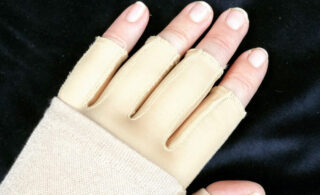
- Compression — bandaging initially, then compression garments long-term. The NHS provides custom-made compression garments every 6 months
- Exercise — to keep lymph moving
- Skin care — to protect against cellulitis
You can read more about these techniques here
Can you have surgery for lymphoedema?
There are now surgical options for treating lymphoedema, but they’re not done in every hospital as they need specialist imaging systems and operating microscopes, so you may have to travel to be treated.
- LVA or Lymphovenous anastomosis (also called LYMPHA)
Tiny lymphatic vessels are connected directly to small veins, creating a new drainage pathway, essentially bypassing the blockage.vii
Lymphatics are joined into a vein in the armpit so any scar tissue that forms in the armpit from the axillary clearance is less likely to cause lymphoedema.
‘This is an operation that is carried out at the time the lymph nodes are removed (axillary clearance) to try to prevent lymphoedema even happening – it’s essentially a bypass operation to connect a lymphatic channel and a vein,’ explains Mr Ramsey. ‘The LVA or LYMPHA may reduce your chance of developing lymphoedema but studies are ongoing to prove this.
‘LVAs can also be done on women with symptoms and signs of lymphoedema – this time the bypass is done in the arm to bypass the blockage caused by the axillary clearance.
‘This seems to work for some patients but not others. We are currently recruiting for the PRELUDE trial at the Royal Marsden which will evaluate the effectiveness of the procedure. To be eligible women need to be within one year of their lymphoedema diagnosis. Patients are randomised to either just have compression therapy or have a compression sleeve and and LVA. We are hoping to show there are benefits.’
Lorraine Brown,a specialist lymphoedema nurse and co-chair of the British Lymphology Society says she has had patients who have benefited from LVA in the early and moderate phases of their lymphoedema.
‘They have all however, had to self fund. It is difficult to generalise as there are so many individual factors here, mainly financial constraints but also quality of life and what patients choose,’ she says.
‘There is no standardised guidance yet on this, so I think all patients need to be made aware so they can make an informed choice and look into this further if they wish.’
- Vascularised lymph node transfer VLNT
‘This a technique where you take a healthy lymph node from somewhere else in the body such as the groin, the neck or inside the abdomen and place it either in the armpit that has had axillary clearance or in the arm affected by lymphoedema, ‘explains Mr Ramsey.
‘The trouble with this technique is that removing a lymph node somewhere else can result in lymphoedema in another part of the body. The research evidence for its effectiveness is not there yet, although one small study viii showed a statistically significant benefit.’
What treatments are there for breast lymphoedema?
‘Lying face-down encourages drainage of the breast, so many women find that spending a few minutes each day lying on their front reduces that heavy feeling.’
Other treatments include manual lymphatic massage to redirect fluid, using Kinesio tape to encourage drainage in the breast, foam padding inside the bra to add more support and advice about weight management. ix
Can I have blood taken or blood pressure readings on my affected arm?
‘Almost every woman is told that she can’t have blood tests or blood pressure taken from her breast cancer arm, says Dr O’Riordan.
‘The theory was that it could damage the lymph vessels and increase the risk of lymphoedema.’
However, a study published in 2016 x that followed 632 patients and took over 3,000 blood pressure measurements and blood draws in affected arms found no association with lymphoedema. None.
‘If you need routine bloods, and there’s an experienced phlebotomist available, it’s fine to use the affected arm. Although I still automatically give them the other side. If you know it’s hard to find your veins, get them to use the other side. It’s not a blanket rule anymore. Use the side that feels best for you,’ says Dr O’Riordan.
Can I use saunas and hot tubs, or have hot baths?
‘There’s no good evidence that occasional heat exposure triggers lymphoedema in women who don’t have it. It’s fine to have a hot bath, use a hot tub or sauna, but be sensible and don’t bake for half an hour at a time,’ says Dr ORiordan.
‘If you do have lymphoedema, prolonged intense heat can temporarily make it worse, so if that’s you, try it cautiously and see how you respond.’
Should I wear a compression sleeve on flights?
‘I sought a second opinion from an oncologist who told me I should wear a compression sleeve on long haul flights, but there is no evidence to support this. Flying doesn’t increase the risk of lymphoedema,’ says Dr O’ Riordan.
‘If you already have lymphoedema, wearing a sleeve on a long flight may help manage existing swelling though.’
Can I have manicures, massages, or beauty treatments if I have lymphoedema flights?
If you already have lymphoedema, you do need to be careful about skin integrity and infection risk.
‘A cut or break in the skin can trigger cellulitis, which can worsen lymphoedema, says Dr O’ Riordan.
‘But if you don’t have lymphoedema, it’s safe to have a professional manicure from a clean salon. Massages are great as well. There’s no reason to avoid them – although your spa might want you to get a letter from your doctor for their insurance policy, as they wrongly believe massage can make cancer spread (it doesn’t).
Should I avoid lifting heavy objects?
‘This is the myth that has probably caused the most unnecessary suffering,’ says Dr O’ Riordan.
‘For years, women were told, ‘don’t lift more than a few kilos’, ‘don’t strain’, ‘don’t exercise your arm’, but the evidence now says the exact opposite.’
The PAL trial xi— a large randomised controlled study — showed that supervised weight training actually reduced the incidence and severity of lymphoedema in women who already had it.
‘The lymphatic system needs movement to work. Exercise — including upper body exercise — is beneficial and not something to fear,’ says Dr O’ Riordan.
Watch Dr O’ Riordan’s video on lymphoedema here: https://www.youtube.com/watch?v=roAeDALOi54

Breast cancer support: book classes, therapies and workshops
In-person or online, wherever you are in the UK. Future Dreams offers a wide variety of group and individual support for women at any stage of a breast cancer journey.
Further information
Future Dreams hold a range of support groups, classes, workshops and events to help you and your carers during your breast cancer diagnosis. These are held both online and in person at the London-based Future Dreams House. To see what’s on offer and to book your place, see here.
To return to the homepage of our Information Hub, click here where you can access more helpful information, practical advice, personal stories and more.
The information and content provided in all guest articles is intended for information and educational purposes only and is not intended to substitute for professional medical advice. It is important that all personalised care decisions should be made by your medical team. Please contact your medical team for advice on anything covered in this article and/or in relation to your personal situation. Please note that unless otherwise stated, Future Dreams has no affiliation to the guest author of this article and he/she/they have not been paid to write this article. There may be alternative options/products/information available which we encourage you to research when making decisions about treatment and support. The content of this article was created by Dr Tasha Gandamihardja, an oncoplastic breast surgeon and podcaster and we accept no responsibility for the accuracy or otherwise of the contents of this article.
Share


SUPPORT RESEARCH EDUCATION
Donate to those touched by breast cancer
Sylvie and Danielle began Future Dreams with just £100 in 2008. They believed nobody should face breast cancer alone. Their legacy lives on in Future Dreams. We couldn’t continue to fund support services for those touched by breast cancer, raise awareness of breast cancer and promote early diagnosis and advance research into secondary breast cancer without your help. Please consider partnering with us or making a donation.