


Lymphoedema nurses Lorriane Brown and Yolande Borthwick co-chairs of the British Lymphology Society answer your questions about NHS treatments for lymphoedema, including compression therapy, bandaging and manual lymphatic drainage
Q: If you are referred to an NHS lymphoedema clinician – what treatments are available as a first line?
“If you have lymphoedema, the usual treatments are skin care advice to minimise the risk of infection, this is because you are at a greater risk of infection following having the lymph nodes removed.
Exercise is also really important as the lymphatic system works better if there is muscle movement.
Compression is also really key, this is usually recommended even in the early stages to prevent progression/worsening of symptoms. At the moment it is not standard practice to use compression as a prevention due to lack of evidence.”
Q: What is manual lymphatic drainage?
Manual lymphatic drainage(MLD) is a specialised medical massage technique that encourages lymph fluid to drain away from the swollen area.
MLD can be useful but it is not essential in most scenarios, this is because the MLD takes a long time e.g. 30 minutes and the benefits are short lived. But in some cases ,it can be really beneficial to be shown by your clinician how to do MLD (also known as self lymphatic drainage(SLD,) possibly more so in the early stages, although the evidence on this is limited. However, it can be very empowering for patients to be taught how to do SLD to themselves. Some people choose to pay for regular MLD but there is no evidence to support the need for this, but some people choose to if they are able to self fund and find it pleasant and it relieves symptoms.
Other patients in this scenario may buy a compression pump, as this can be used at home and the pump compresses and mimics the massage. Ideally before purchasing a pump, it should be discussed with a health care professional as there are contraindications.
Q: What about bandaging techniques?
Bandaging treatment is often used when the lymphoedema is more established or if there is a shape distortion in the limp that needs correcting. The bandaging helps soften harder swelling (referred to as fibrosis). Often when bandaging is offered, then MLD is also recommended, particularly if there is swelling in the root of the limb, e.g. in the shoulder or the hip.
Q: What compression garment are you entitled to on the NHS and how frequently will you get a new one (is it usually every 6 months)?
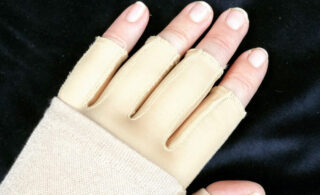
Service provision models vary, some clinics use formularies and therefore the garments you are offered will be from the formulary, however many clinics use the prescription route. This means if the garment is available on prescription your clinician will assess your lymphoedema and order it that way. The general recommendation is two garments every 6 months per area of lymphoedema. This is because the manufacturers guarantee the garments for 6 months, e.g. if it is in your arm and hand, you may need two sleeves and two gloves per 6 months. There is a huge range of different types of garments, with different classifications and fabric types your clinician would assess what you need.
Q: Is lymphoedema always progressive?
If lymphoedema is treated optimally the symptoms of swelling can be controlled, if it is not treated symptoms can worsen, however this will depend on the individual’s risk factors, e.g. if the individual has risk factors such as high body mass index ( BMI) and a sedentary lifestyle.
If lymphoedema does progress, it is not the individual’s fault as there may be genetic factors that make someone at risk of progression, or they may be unlucky and get cellulitis.
So, no it is not always progressive, it can be controlled.
Q: Does lymphoedema get worse in hot weather?
It often does, but this should be transient and with treatment should return to normal levels, this is due to vasodilation and more capillary filtration in hot weather, meaning higher lymphatic drainage is required. In layman’s terms this means more fluid leaks out of our blood vessels when it is hot, and this means more fluid needs to be collected back up by the lymphatics. So, it may take a few days for the lymphatics to catch up.
Q: How long does a course of treatment with a lymphoedema clinician typically last on average? After the course of treatment when would you be seen again? Or is there a lot of regional variation on this?
In most cases at the first appointment, you would be given a self-management plan, asked to do some exercises, taught self-massage and skin care and measured for a compression garment, this may need to be ordered, or in some cases may be fitted from stock.
Weight management will be discussed if it is appropriate, as we know that a high BMI increases the risks of lymphoedema, so aiming for an optimum body weight and maintaining this is part of the management. This would typically be a 30 to 60 minute appointment depending on local protocol, follow-up also varies, in some cases clinics use patient initiated follow-up others will book a follow-up this may be over the phone or face to face. But essentially you should be offered a management plan that works and reduces your lymphoedema. If you need more intensive treatment like bandaging, this may be over three days or possibly up to three weeks because different centres offer this in different ways or the plan would vary depending on your swelling.
Q: In terms of self care what do you recommend? (massage techniques, skin care to prevent cellulitis, losing weight if overweight, any specific exercises?)
Yes all of that!
There is no standard exercise, but listening to your body is important to ensure the exercises helps and does not worsen your symptoms.
For more information see the British Lymphology Society Fact sheet on exercise
The charity Macmillan Cancer recommends trying breathing exercises before and after MLD and SLD to help lymphatic drainage. More details are available here.
Q: Are any complementary health techniques helpful?
General good health is what we would recommend, anything that makes someone happy and want to move well, eat healthily.
Patients often report ways they have identified that benefit them, this nay be an exercise regime, a dietary change, or a routine change meaning they get more rest or elevation or more exercise.
The main advice is to listen to your body and trust your instincts.
Further information
Future Dreams hold a range of support groups, classes, workshops and events to help you and your carers during your breast cancer diagnosis. These are held both online and in person at the London-based Future Dreams House. To see what’s on offer and to book your place, see here.
To return to the homepage of our Information Hub, click here where you can access more helpful information, practical advice, personal stories and more.
The information and content provided in all guest articles is intended for information and educational purposes only and is not intended to substitute for professional medical advice. It is important that all personalised care decisions should be made by your medical team. Please contact your medical team for advice on anything covered in this article and/or in relation to your personal situation. Please note that unless otherwise stated, Future Dreams has no affiliation to the guest author of this article and he/she/they have not been paid to write this article. There may be alternative options/products/information available which we encourage you to research when making decisions about treatment and support. The content of this article was created by Dr Tasha Gandamihardja, an oncoplastic breast surgeon and podcaster and we accept no responsibility for the accuracy or otherwise of the contents of this article.
Share



SUPPORT RESEARCH EDUCATION
Donate to those touched by breast cancer
Sylvie and Danielle began Future Dreams with just £100 in 2008. They believed nobody should face breast cancer alone. Their legacy lives on in Future Dreams. We couldn’t continue to fund support services for those touched by breast cancer, raise awareness of breast cancer and promote early diagnosis and advance research into secondary breast cancer without your help. Please consider partnering with us or making a donation.